2 Days in, 3Y0K is not a good DXpedition
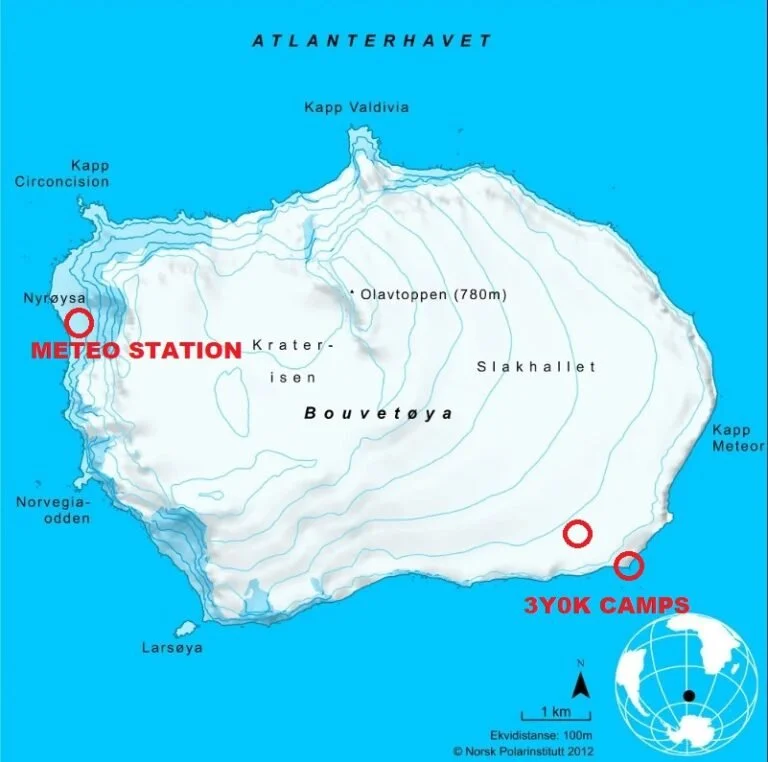
Bouvet with Camp Fie at the bottom and Camp Meteo (for NA) upper left
Before you all hate on me, understand that what these hams are doing is daunting, brave, expensive, and hard to do. I think, though, that the team made some serious ‘before sailing’ decisions that are now showing up in the DXpedition. What follows are:
FT8 selection of Fox and Hounds
The lack of frequencies for a band plan, except for FT8
The lack of a coherent communications strategy
FT8 Selection of Fox and Hounds
When Superfox was introduced a couple (?) of years ago, it was touted as solving some serious issues with Fox and Hounds. Those issues were:
Equal power across all streams. If you had one stream at 100 watts, you had 100 watts at five streams. Fox and Hounds reduces your power by 50% for each additional stream you add.
Increased bandwidth for the pileups. Fox and Hounds requires the pileup to be above 1000 Hz, compressing it into a smaller space. Superfox did not have a restriction.
Because Superfox required an authentication token from a reputable DX organization (NCDXA, Indexa, for example), you could be assured you were working the real DX station and not some pirate. Fox and Hounds can be run by anyone.
Yet, 3Y0K is running Fox and Hounds. If ever there was a DXpedition that needed equal power across all streams, increased bandwidth for the pileup, and protection from pirates, 3Y0K would seem to desperately need Superfox.
To be fair, not many DXpeditions have not used Superfox. I don’t know the reasons. Most DXpeditions today use MSHV, a program that delivers equal power across all streams and the full bandwidth for pileups. MSHV also allows users (the ‘hounds’) to use standard WSJT protocols instead of having to switch to Fox and Hounds or Superfox mode. Yet 3Y0K is not using MSHV either, despite those big advantages.
I have no idea of the decision made to use Fox and Hounds. This, in my opinion, is a big miss on the team’s part and is causing more intense pileups in limited bandwidth, if not slower rates as well.
The lack of frequencies for a band plan, except for FT8
There are two problems here.
The lack of specific frequencies for use on each band
Here is the band plan:
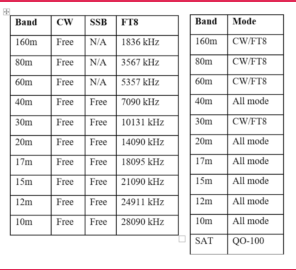
The 3Y0K “band plan”
You’ll notice that the FT8 column has specific frequencies listed - 24911 kHz, 18095 kHz, etc. Then look at the CW and SSB columns - Free. or N/A. N/A, of course, means they are not planning on doing SSB on those bands, which is fine and (IMHO) a good choice. But free? The operator gets to pick any frequency on the bands they want (with some excluded DX frequencies listed on a separate table)? This has a couple of serious problems:
This prevents us from tuning to specific frequencies to see if they are operating there, separate from spots, and regardless of what VOCAP may tell us about propagation.
It promotes pirates. Pirates can pick any frequency they want, and an operator would have no clue if that station calling was legitimate without confirmation from the Facebook feed, which is not that timely, or as timely as they can get it (more on this later). If the pirate was calling on a planned frequency from the table, that can be compared to spots, VOCAP, and your own direction-finding, much easier than if someone just shows up on a random frequency.
And then, the weirdest band plan I’ve ever seen:
The Deliberate QRM (DQRM) band plan
Here’s the table from the website:
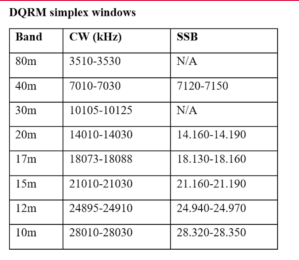
The DQRM Band Plan
Pretend you are in a contest calling CQ. Instead of ‘CQ Contest K9JY’, you just give your call, K9JY, repeatedly. 3Y0K isn’t going to be on a specific frequency listening up (e.g., 14010), but instead is going to go up and down the frequency range on the table (14010-14030) and calling you SIMPLEX. No split operation, just you calling blindly every two seconds until 3Y0K magically shows up on your frequency and gives you a call, just like in a contest.
I have issues with this approach:
There is no description of when this will be put into effect - how do operators know that they have switched from the normal ‘listening up’ scenario to this DQRM method? No one knows. And in case you needed an example of DQRM overriding the 3Y0K signal, all you have to do is listen to any SSB pileup today, and you’ll get the full Monty: music, news reports, people tuning up, not using split correctly, and the band police piling on all that be correcting or commenting on it all. So much for a Code of Conduct. Not much has changed in the 50 years I’ve been in ham radio.
Now, think about you being in the pileup, and 3Y0K goes into this DQRM mode. Within our 20M example, hundreds of stations will be calling in the 20 kHz window - and you can bet most of them will be loud. And each of them is calling in their own 2-3 second interval. So, a wall of constantly calling 599/59+ signals. Then, weak signal 3Y0K - calling from the remotest part of Earth - decides to call you. Lucky you - except the probability of hearing a weak signal 3Y0K calling you against a 20 over 9 wall of other stations calling is close to zero. For everybody, not just you. No rate. It solves the DQRM problem, except the team is now dealing with legit QRM from all the stations legitimately calling them in the bandwidth on the table.
It’s the dumbest idea I’ve seen for handling a pileup.
The lack of a coherent communications strategy
There is no logistics communication happening
The Bouvet DXpedition is, understandably, dealing with a lot of logistics. They have made it a big deal about it - the ship, the helicopter, the sailing, the delivery of supplies to the islands, the three camps they’ve identified on their website that needs building.
Before landing, there was a clear process being communicated: get a weather window, build the complete camp, then build the stations, then get on the air. Since then, while on the island, we’ve received communications that the camps, antennas, and amplifiers are being built.
What camps are in what stage of completion? We don’t know.
What stations are done in each of the camps? We don’t know.
What antennas are done (and what are they) in each of the camps? We don’t know.
What amplifiers have been placed and are working in each camp? We don’t know.
This sounds like whining, but it’s not. Camp Fie, the camp used in the 2023 DXpedition and in the current one, has a 300-foot rock wall between it and North America. The only practical way for an NA station to work 3Y0K from Camp Fie is via the long path. If you have a beam, there’s a big difference between long and short path (obviously)! If we knew that Camp Fie was the only camp working, it would be a material difference to how NA stations will try to work 3Y0K. If we knew certain bands were set up at Camp Mateo, built on the other side of the island with a clear path to NA, we’d be looking for them short path - and a much stronger signal.
Look, the logistics for this DXpedition are all world-class difficult, and the team is executing the build-out. But we know oh-so-little about it. It would at least be nice to know when they are done building and are fully operational. Today was supposed to be amplifier day, the last day, but we don’t know if anything on the island has actually been completed.
The limited distribution of communications
Oh, have we been spoiled. Just before 3Y0K, we had KP5/NP3VI and J51A DXpeditions. They distributed information to the Daily DX, DX World, Facebook, their websites, and other places that I don’t know about. But if you wanted to know what was going on with those DXpeditions, it was easy to find. Planned, timed, and distributed.
For 3Y0K, we have the Facebook page. And that’s it. According to their webpage as of this writing, they are still traveling to the island as of February 25th. Instead of getting information from DX sources, we have to continuously update the Facebook page - a page with only 5.4 thousand followers. A mere fraction of the total number of hams is trying to work this DXpedition.
And the administrator is doing a good job with the information he is getting - mostly confirming QRV on certain bands and modes. But he’s the only pilot, if you will, posting information. And he sleeps, so there is no confirmation of anything during that time.
With all the Pilots worldwide and 3Y0K being the biggest DXpedition of the year, you’d think there would have been a ‘press plan’ to inform the DX community about the operation on the island. KP5/NP3VI and J51A did. 3Y0K has not.
All of these problems are fixable (except, perhaps, the FT8 F/H issue). They could publish frequencies. They could forget the DQRM approach. They could communicate much better and with a better plan. It would reduce the frustration I see out there for people who want the DXpedition succeed, including me.
3Y0K will get a lot of contacts and a lot of ATNO’s. But right now, it could be a lot better-run DXpedition.
UPDATE: About a half hour after this post went live, I received the first more ‘comprehensive’ update on the status of the camps, radios, and antennas via the Daily DX. If that continues, it will greatly improve communication. Interestingly, that was NOT posted on the DXpeditions Facebook page.